How many words does one actually need?

Part I
Recently, I finished reading an English translation of a Malayalam novel, The Wanderer, written by V. Shinilal who won Kerala Sahitya Akademi Award in 2022 for it. The original Malayalam title is Sambarkkakranthi (North Indians can read the original title as Samparka Kranti) and it describes the experiences of the protagonist, Karamchand, as he travels in the train from Trivandrum to New Delhi. The author has pulled real characters from history and made them converse in his novel to make his point in an interesting way. I am reproducing few of those conversations below:
First conversation between Narendra Dhabolkar from Pune, the rationalist and founder of Maharashtra Andhshraddha Nirmoolan Samiti and his assassin. In the novel, Dhabolkar is killed in the train whereas he was actually assassinated in Pune, his hometown.
“Do you believe that you can kill me with that pistol?”
“Your body is not bulletproof, is it?”
“Ha, ha, ha, you are mistaken again. As much as you are not a single individual, I too am not one. Dhabolkar is an idea. Concepts do not die. What about the weapon in your hand? It will corrode and become unusable.”
“The weapon is likewise, old man. This is no ordinary pistol. This pistol took Gandhi’s life. In that sense, you are a very lucky man.”
“You fool! Did Gandhi ever die? Ideas are a continuum. From one it will turn in to another endlessly, evolve and go forward.”
Second conversation between Siddhartha (later, Buddha) and Shankaran (later, Shankaracharya):
“I come from the foothills of the Himalaya.”
“You are so fortunate. You can see the Himalayas all the time.”
“What do you mean fortunate? You look in any direction and all you see is the Himalaya mountain like torn pieces of white fabric. And bone chilling cold. Anyone would get fed up.”
“Aiyoo, don’t say so. All right, where are you going?”
“I am going deep into the south. There is a place where three seas meet and their waves lap against one another. The sea where the waters provide salvation and turn into a phenomenon. Ah! The sea. What a magnificent sight it would be.”
“Ha ha ha…it is nothing like that, my friend. Nothing of what you say is there, only water. What will you get by gazing at it? I live on the sea shore. You are not going to get anything that I haven’t go so far, or are you?”
“All right, what about you?”
“I am going to the Himalayas.”
“And then?”
“And the nothing. My life’s sole ambition is to go there.”
“What is your name?”
“Siddhartha.”
“When did you start your journey?”
“Two thousand five hundred years ago. I became the Buddha on this journey. What is your name?”
“Shankaran.”
Tucked in, many pages away in the novel, is this sentence which actually encapsulates the meaning of the above conversation: ‘Every journey is a venture into the extra-terrestrial space to find the culmination of futility.’
Third Conversation is just random between two unnamed people. It concludes with an intriguing deduction.
“What helps to maintain the system?”
“Fear.”
“Fear of what?”
“Fear that liberty may be lost.”
“What sustains the nation?”
“Policing.”
“No, the police are only an instrument.”
“Fear.”
“Fear of what?”
“Fear of the possible loss of liberty.”
“Isn’t the right of speech included in that?”
“Definitely.”
“The right to eat the food one likes?”
“Most certainly.”
“Isn’t the fear that these rights may be lost that compels a person to abide by the system?”
“Yes.”
“So where does the loss of liberty happen?”
“Inside a prison.”
“In that case, the final question is- what sustains a system or a nation?”
“Jail.”
Fourth Conversation (sarcastic) between a European traveler and Karamchand:
“You Indians are past masters at burning people alive, aren’t you? Indians are obsessed with arson. You proved that in Chauri Chaura too.”
“Not only in Chauri Chaura. In Godhra, in Gujarat riots, in the anti-sikh riots, in anti- and pro-reservation agitations.”
“Do you know the reason?”
“No.”
“Your primary Veda itself has its origins in fire.”
In addition to the many conversations in the novel, there are passages and sentences that are at times quite engaging and at times bizarre. Here are few samples:
1) How will my brand of politics succeed in a society that believes Ashwatthama has reappeared; one which lays national highways to cater to Hanuman.
2) Carel’s Brothel in Budhwar street of Pune. Discount for Keralites. Estd 1945.
3) An Indian woman’s waist and hip are designed to seat a pot of water. No, they are designed to carry a child with ease. If that is the case the male of the species is cunning; he fashioned the pot in the shape of a child and handed it over to the woman.
Part II
When I was allotted Kerala cadre, learning Malayalam became an essential requirement because every All India Service officer is expected to have a functional knowledge of the local language. In the degree of difficulty, Malayalam and Tamil are considered the toughest Indian languages to learn. I took great comfort in the fact that one needs to know just 3000 words of any language in order to carry on daily conversations with the native people. I presumed that if I learnt 10 new words every day, I would be reasonably good in about a year.
You may be wondering as to how I have digressed suddenly in Part II from the description of the novel, The Wanderer, given in Part I. Well, not exactly. As informed at the beginning I read the English version of the novel. The translation is done by Nandakumar. K who is the grandson of Mahakavi Vallathol Narayana Menon(1878-1958). The latter was a renowned nationalist poet who established Kerala Kalamandalam- a center for training in performing arts like Kathakali, Kutiyattam, mridangam and many others. Kerala Kalamandalam is a deemed university today.
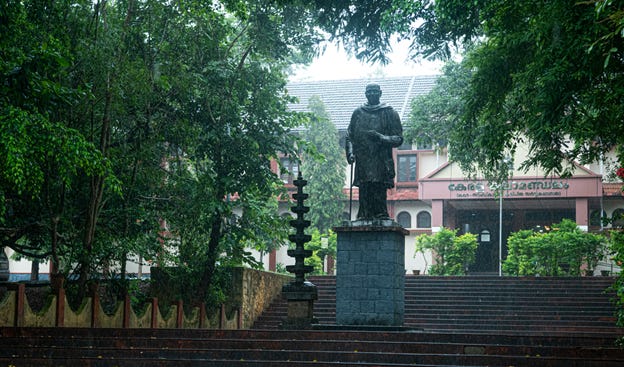
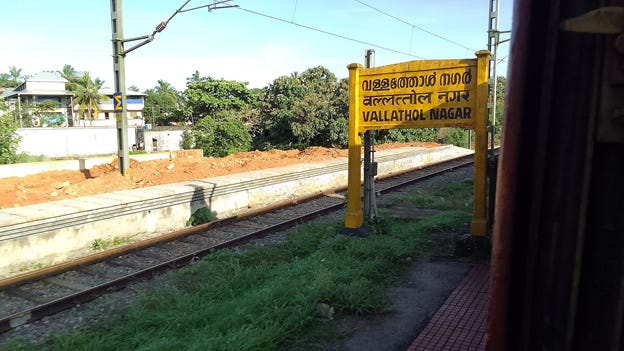
Reading Nandakumar’s translation of Sambarkkakranthi in English, I came across so many words that I had never read or heard earlier; even so when I claim (maybe, erroneously) that I am well read! I leave it to the readers to measure their knowledge of English words against the vocabulary of Nandakumar who lives in Dubai and is a business analyst by profession!
Zeitgeist (actually a German word meaning spirit of the time, vibe)
Omnium gatherum
Nonce
Plenipotentiary
Smorgasbord
Paterfamilias
Susurration
Residuum
Carracks
Arquebus
Makkah ( I knew it as Mecca- holy place of Muslims)
Factotums
Thingamajig
Beribboned ( somebody who has been given a ribbon)
Minatory
Antiphonal
Braggadocio
Suppurating
Peregrinations
Metier ( This is actually a French word)
Acme
Vim ( robust energy. I knew only a washing powder by that name.)
Imprecations
Pasquinade
Ululated
Hir (gender-neutral pronoun used as an alternative to him/her)
In my defense, Part II of this post is not a digression. I too qualify as “The Wanderer.”
Nice one sir